Why Agnys exists
Autonomous work needs an accountable record
AI agents are moving from demonstrations into workflows that read business data, call external tools, modify files, run commands and trigger downstream systems. Conventional application logs may show that an endpoint responded or that a job completed, but they rarely preserve the complete relationship between an initiating request, a model decision, the tools selected, human oversight and the final side effect.
Agnys was created around a simple operating principle: when software can act with increasing autonomy, the people responsible for that software should be able to reconstruct its work. The record should be useful during an engineering incident, understandable to a security or compliance reviewer, and portable enough to support customer assurance without forcing every team to assemble screenshots from several vendor consoles.
- Connect the trigger, reasoning context, actions and outcomes of an agent run
- Keep human approval attached to the exact action it governed
- Preserve enough context for investigation without confusing a log with legal judgment
Founder
Built by Ashish Vardhan Reddy Avuluri
Ashish Vardhan Reddy Avuluri is the founder and lead developer of Agnys. His work sits at the intersection of AI agent engineering, cybersecurity and evidence design: how to preserve a record that helps another person understand what autonomous software actually did.
Ashish earned a Master of Science in Cybersecurity and Information Assurance from the University of Michigan-Dearborn and has earned the CompTIA Security+ certification. He is based in Michigan and publishes practical work on agent traceability, observability, oversight and tamper-evident records.
Agnys is the product expression of that focus. The public Agent Evidence Benchmark is the research expression: a scenario-based method for testing capture coverage, attribution, oversight linkage, integrity and reconstruction. Ashish welcomes technical criticism and practitioner review through contact@agnys.net or his public LinkedIn profile.
- Founder and lead developer of Agnys
- MS, Cybersecurity and Information Assurance, University of Michigan-Dearborn
- Focus: evidence infrastructure for consequential AI agent activity
What the product does
One operational history across different agent tools
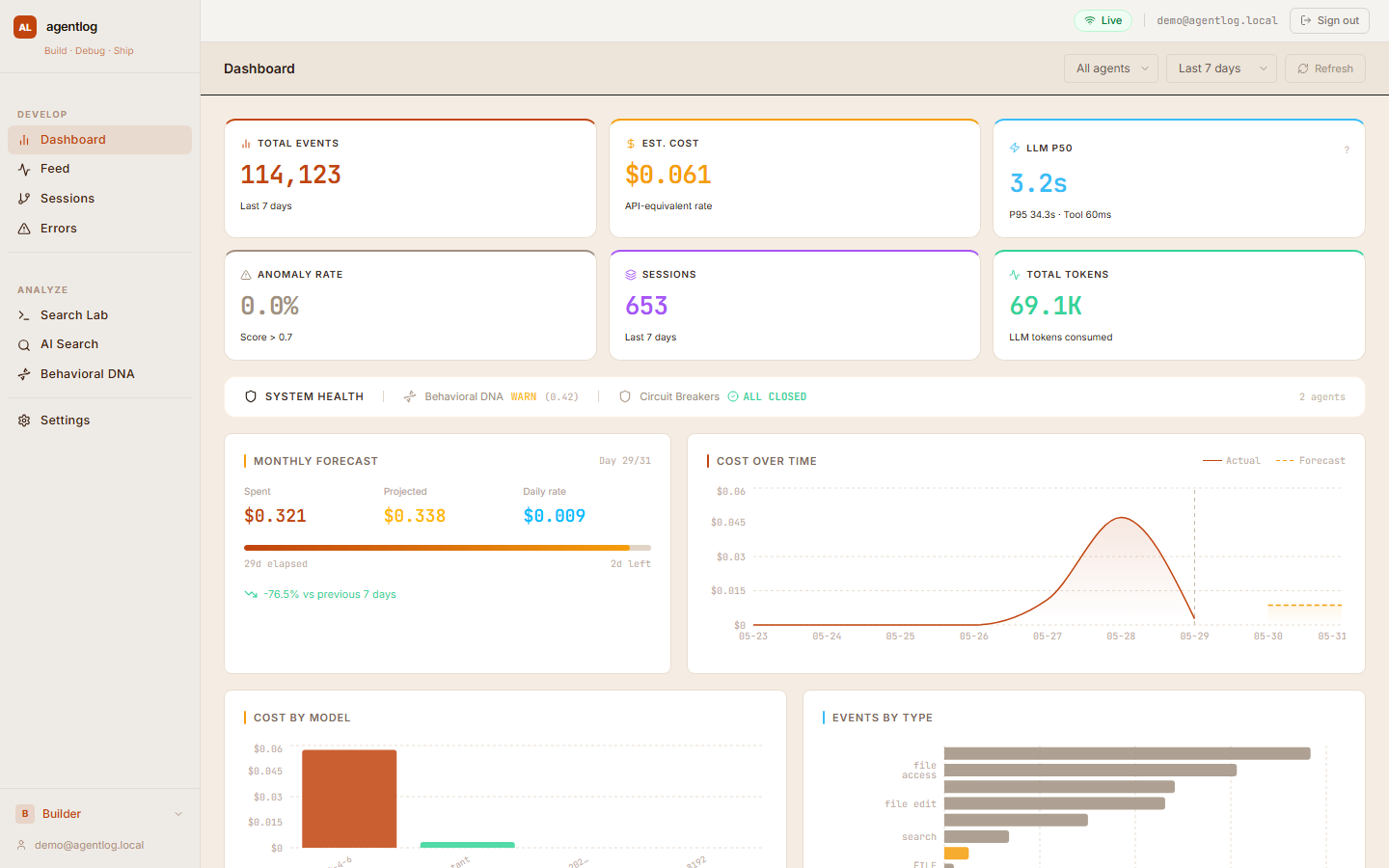
Agnys captures model calls and the events that happen around them: tool use, file activity, shell execution, MCP calls, approvals, cost and outcomes. The Agnys Forwarder supports passive capture methods suited to different tools, while SDKs, browser capture and webhooks support teams that control their own runtime. Captured events are joined into session traces rather than left as isolated activity counters.
That shared event model powers a live feed, forensic replay, structured search, behavioral baselines, anomaly detection and evidence exports. Builders can investigate a failed run, security teams can examine unusual activity, and governance teams can review the same underlying record through views suited to their responsibilities. Agnys does not ask those groups to trust separate versions of what happened.
- Agent and model attribution across captured events
- Chronological replay from initiation through side effect
- PDF, CSV and JSON outputs for human and machine review
Evidence design
Separate capture, integrity and interpretation
Strong evidence practices distinguish three questions. Capture asks whether the important event entered the record. Integrity asks whether the recorded sequence was changed later. Interpretation asks what the record means under a policy, contract, control framework or law. Treating those questions as interchangeable creates false confidence, so Agnys keeps the underlying event history available alongside scores, alerts and reports.
Each captured event can participate in a per-agent SHA-256 hash chain, with previous-hash references preserving sequence relationships. Chain tips can be compared with write-once anchors. These mechanisms can expose later modification; they do not independently prove that every upstream system reported truthful data or that a deployment satisfies every legal duty. Coverage, access, retention, review and accountability remain part of the organization’s operating program.
- Capture coverage is documented and testable
- Hash-chain verification provides an integrity signal, not a truth oracle
- Compliance views support qualified decisions rather than replacing them
Who it serves
A shared layer for teams with different questions
AI platform teams need to know why a run failed and whether a new release changed behavior. Security teams need attribution, scope and a timeline around unusual access or tool use. Compliance leaders need records that can be reviewed against internal controls and applicable requirements. Business owners and enterprise buyers need a credible answer when they ask how an agent is monitored after deployment.
Agnys is designed for organizations selling AI agents to companies, businesses introducing agents into sensitive workflows, and regulated enterprises that require stronger operational evidence. The platform is model- and tool-oriented rather than tied to a single agent vendor, because real organizations often test several assistants, coding tools, custom agents and orchestration frameworks at once.
Markets and integrations
Focused on US and European enterprise requirements
Agnys primarily serves organizations in the United States, European Union, Switzerland, the United Kingdom and related European markets. That focus reflects the needs of enterprise buyers managing security, accountability and regulatory expectations across borders. The product remains usable elsewhere, but published guidance prioritizes the markets where Agnys is actively building its commercial and compliance position.
Confirmed integration coverage includes Claude, LangChain, VS Code, LangGraph, AutoGen Studio, LM Studio, Ollama and Antigravity. Agnys can combine supported passive capture paths with direct instrumentation so hosted assistants, custom orchestration frameworks, developer environments and local model runtimes can contribute to one reviewable event history.
- United States enterprise governance and customer-assurance workflows
- European Union AI Act and data-governance considerations
- Switzerland, the United Kingdom and adjacent European markets
- Eight confirmed integration environments with version-specific validation
How claims are handled
Product facts should stay verifiable
Agnys product pages use real interface screenshots and explain the limits of integrity and compliance features. Regulatory pages link to primary sources and identify when the content was reviewed. When rules or implementation timelines change, the source material should be checked again rather than repeating an outdated summary. No monitoring product, including Agnys, can guarantee that an organization is compliant solely because it is installed.
Teams evaluating Agnys should test capture coverage against their own agents, confirm the effect on latency and reliability, review data handling and retention choices, and verify exported evidence with the people who will rely on it. Questions about the product, evaluation process or published material can be sent to contact@agnys.net.
- Original product views instead of stock illustrations
- Explicit limits around integrity and compliance claims
- A public contact route for product and content questions