The missing record
Ordinary application logs do not explain an agent run
An AI agent can call a model, read a file, invoke an external tool, ask a person for approval and change a production system in a single run. Those events often land in different consoles with different timestamps and identifiers. When something goes wrong, the team has fragments rather than a defensible account of what the agent actually did.
An AI agent audit trail should preserve the sequence and relationship between those actions. Agnys threads captured events into a session-level trace, retaining the actor, tool, timing and outcome needed to move from a vague incident report to a concrete reconstruction. The record is designed for engineering investigation and governance review, not merely dashboard activity counts.
- See the trigger, model request, tool calls and resulting side effects together
- Distinguish human actions from model-driven and agent-to-agent actions
- Preserve event order across tools instead of correlating several log systems manually
Complete capture
Record the actions that determine the outcome
A useful trail goes beyond prompts and responses. Agents affect the world through tools: they query databases, edit files, run shell commands, call MCP servers and trigger workflows. Agnys captures those operational events alongside model activity so a reviewer can see not only what the model said, but what the system did next.
The Agnys Forwarder uses capture mechanisms suited to each tool, including HTTPS interception, log tailing, on-disk readers, CDP and MCP-aware channels. Teams that own the agent runtime can also use Python and Node SDKs, browser capture or webhooks. The result is one evidence model even when the underlying agents use different vendors and interfaces.
- Model provider, endpoint, timing and usage metadata
- Tool name, arguments, result and associated trace
- File modifications, shell execution and MCP activity
- Human approval events and the action each approval covered
Tamper evidence
Make later changes visible
A mutable database row can be edited after an incident. That may be acceptable for operational telemetry, but it weakens the value of a record intended to demonstrate what happened at a particular moment. Agnys calculates a SHA-256 hash for each event using the previous event hash, creating a per-agent chain where changing an earlier record breaks every link that follows.
Chain tips can be anchored to write-once storage, providing an external digest against which a later export can be checked. This does not make every statement in a log automatically true; it provides evidence that the recorded sequence has not been silently rewritten. That distinction matters for serious incident reviews, customer assurance and audit preparation.
- Per-agent hash chains preserve sequence integrity
- WORM anchoring provides an external comparison point
- JSON exports retain hash and previous-hash references for verification
Forensic replay
Move from alert to explanation
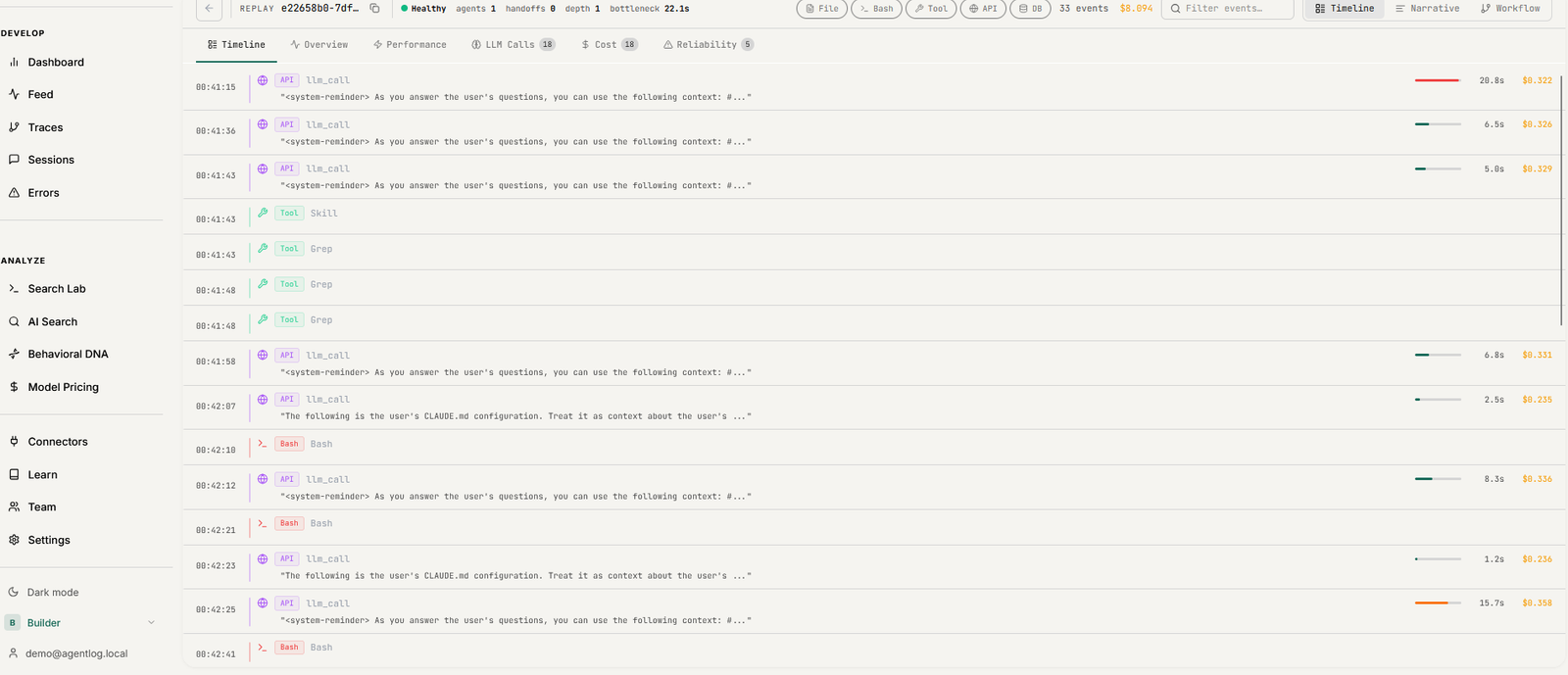
An alert tells a team that a threshold was crossed. Session replay helps explain why. Agnys rebuilds the run in chronological order so reviewers can move from the initiating request through model decisions and tool activity to the final outcome. This supports debugging without requiring access to every original terminal or vendor console.
Replay is especially useful when an agent appears successful at the API level but takes an unexpected route: repeated calls, a wrong file, an unusually broad data query or an approval that arrived too late. The same trace can support an engineering postmortem, a compliance review and a customer-facing explanation while keeping the underlying evidence consistent.
- Investigate unexpected actions and behavioral drift
- Review the context surrounding costly or irreversible tool calls
- Export the same ordered evidence used during the investigation
Meaningful oversight
Connect human approval to the action it governed
A checkbox saying that a workflow has a human in the loop is not enough to demonstrate how oversight worked. Reviewers need to know who approved an action, when approval occurred and whether the approval covered that specific side effect. Agnys correlates the permission moment to the event it authorized and keeps agent-to-agent calls separate from genuine human control.
That relationship makes it possible to calculate oversight ratios, identify irreversible actions that ran without supervision and flag rapid approval patterns that may indicate rubber-stamping. The goal is not to replace a team’s governance policy; it is to give that policy an observable record that can be tested against actual agent behavior.
Operational use
One record for builders, businesses and auditors
Engineering teams can use the trail to reproduce failures and compare agent behavior over time. Security teams can investigate unusual tools, access patterns and command bursts. Compliance leaders can review evidence against internal controls and applicable frameworks. AI builders can give enterprise customers a clearer answer when procurement asks how agent activity is monitored and retained.
Agnys produces searchable traces and exportable PDF, CSV and JSON evidence. The platform can score traces against configured compliance checks, but the result should be treated as decision support rather than a substitute for legal advice, risk ownership or an independent audit. The underlying event record remains available for qualified reviewers to examine directly.