The rule
What Article 12 says about record-keeping
Article 12 applies to high-risk AI systems within the scope of the EU AI Act. The official regulation says those systems must technically allow for the automatic recording of events, commonly described as logs, over the lifetime of the system. The logging capability must support a level of traceability appropriate to the system’s intended purpose.
The regulation connects that traceability to practical objectives: identifying situations where a high-risk system may present a risk or undergo a substantial modification, facilitating post-market monitoring and monitoring system operation. Some biometric systems have additional minimum logging fields. The precise duties therefore depend on the system’s classification, role, use case and other applicable law.
- Automatic recording is a technical capability, not a manual questionnaire
- The event record should be relevant to the intended purpose and risks
- Logs support operational monitoring, post-market monitoring and investigation
Scope first
Not every AI agent is automatically a high-risk system
Using an AI agent does not by itself establish that the system is high-risk under the Act. Classification depends on the intended purpose and whether the system falls within the regulated product or use-case categories. A company may also be a provider, deployer, importer, distributor or another actor, and those roles carry different obligations.
Before treating an Agnys report as compliance evidence, the organization should document the system boundary, intended purpose, actor roles and classification rationale with qualified legal and risk professionals. Agnys can preserve and organize operational events, but software cannot decide the legal scope of a deployment on the customer’s behalf.
- Document what the system does and where it is used
- Identify which organization controls development and deployment
- Record the classification decision and the evidence supporting it
Agent-specific evidence
Translate a broad logging requirement into observable events
Agentic systems create a wider operational surface than a single prediction endpoint. A run can contain several model calls, retrieval, tool selection, external APIs, file changes, commands and human interventions. Capturing only the final response leaves out the actions that often determine risk and impact.
Agnys records those events and connects them into traces. The resulting history can show which model and tool were used, when an action occurred, what system resource was involved, whether a person approved it and what happened next. Teams can then select the fields and retention rules appropriate to their risk assessment rather than relying on a generic activity counter.
- Prompts and model-call metadata
- Tool and MCP calls with their place in the session
- File edits, shell commands and other side effects
- Human approval and attribution events
Traceability
Keep enough context to reconstruct the run
A log is more useful when a reviewer can understand its relationship to the system’s operation. Agnys groups events into a session trace that follows the run from its trigger through decisions, actions and outcome. That structure helps teams investigate a risky event, compare behavior over time and support monitoring without manually joining several unrelated data sources.
Traceability does not mean retaining every sensitive payload without limits. Organizations should apply data minimization, access control, redaction and retention policies appropriate to the purpose of the record and their privacy obligations. Agnys includes PII-oriented detection and configurable retention capabilities, while the customer remains responsible for selecting and governing the data it processes.
Integrity
Preserve evidence that can be checked later
Article 12 focuses on logging capability and traceability; it does not turn any ordinary log store into conclusive evidence. For governance and audit work, teams also need confidence that a historical record was not silently edited after an incident. Agnys uses per-agent SHA-256 hash chains so an alteration to an earlier event changes the chain that follows.
Chain tips can be anchored to write-once storage and exports retain verification fields. This provides tamper evidence, not an unlimited guarantee of authenticity. Reviewers should still examine capture coverage, access controls, system configuration and the provenance of upstream events.
- Sequence-aware hashes expose later modification
- WORM anchoring provides an external digest
- Machine-readable JSON supports independent verification workflows
Retention and review
Treat logging as an operating process, not a one-time setup
The AI Act includes log-retention duties for providers and deployers of high-risk systems in Articles 19 and 26. Article 26 states that deployers keep automatically generated logs under their control for a period appropriate to the intended purpose and at least six months, unless other Union or national law provides otherwise. Different actors and regulated sectors may face additional requirements.
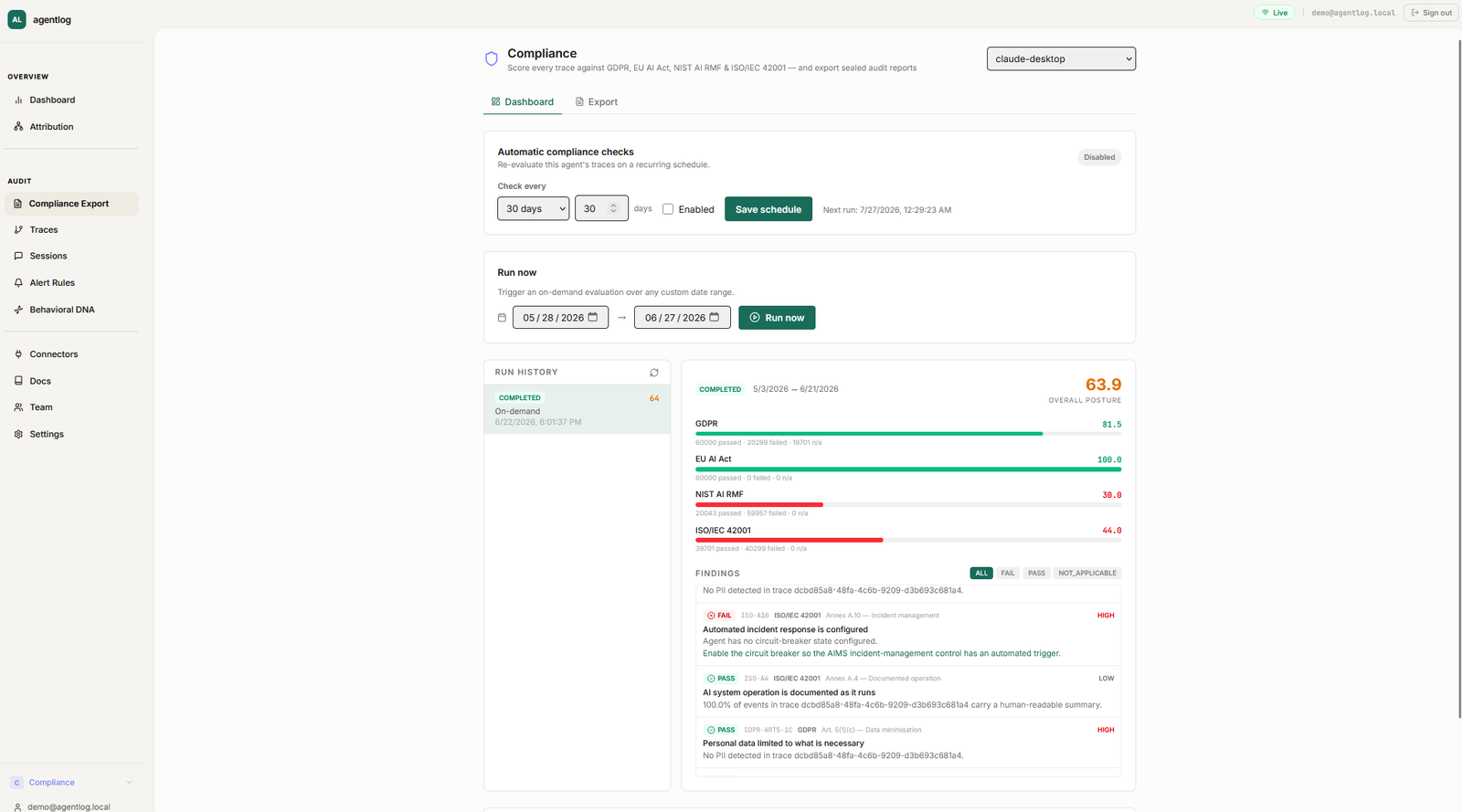
A practical program therefore defines ownership, retention, access, review frequency, incident escalation and evidence export before production deployment. Agnys can schedule checks, surface anomalies and produce PDF, CSV and JSON evidence, while the organization decides who reviews findings and how those findings feed risk management and post-market monitoring.
Implementation timeline
Use current official guidance and keep the plan reviewable
As of this page’s July 2026 review, the European Commission’s implementation materials describe a revised timeline following the political agreement on the AI Omnibus: rules for systems in certain high-risk areas are expected to apply from 2 December 2027, while rules for high-risk systems embedded in regulated products are expected from 2 August 2028. The underlying regulation and implementation measures should be checked again before relying on a deadline.
Teams do not need to wait for an enforcement date to start collecting evidence. Historical records only exist after capture begins. Starting with a scoped logging baseline now gives engineering and compliance teams time to test coverage, retention, oversight and export procedures before those records are requested during procurement, incident review or regulatory assessment.